
How to Search Civil Dockets
Start with Missouri Case.net, the public online index for Wright County state civil cases. Got the case number? Use it. A party-name search works too, though you should narrow it by county, case type, and filing date when the form allows those filters. Before trusting a result as the right Wright civil docket, compare the party roles, style, court, and case category against what you already know.
Once a case opens, read the header first. It frames the record. The dated docket entries then track each filing and court action. A public document link may lead to an attached item. Remote access does not extend to every filing. Old, unclear, paper-only, restricted, or certification-needing cases call for the Wright County Circuit Clerk, who can point you to the right division and the proper record-access procedure.
- Begin with the case number if it appears on a notice, docket, or court paper.
- Use a party-name or filing-date search only when a number is unavailable or a date window is known.
- Narrow to Wright County or the 44th Judicial Circuit where the public interface provides a location choice.
- Check the civil category, filing date, party type, court, and case style before opening the docket.
- Read dated entries, then ask the clerk about a document, copy, fee, or current setting when needed.
Wright Civil Docket Search Fields
Case.net works on an index model. The public-access search keys include a case number, party name, filing date, calendar date, and a judgment-against concept under Missouri's court-record framework. The live form can change. So copy a case number exactly from a court notice rather than guessing punctuation, and treat a broad name-only result with care.
| Search method | Best use | Wright check |
|---|---|---|
| Case number | Locating a known court file | Preserve its prefixes and hyphens; older patterns can differ. |
| Party name | Finding a case when no number is known | Compare party type, filing date, location, and civil category. |
| Filing date | Reviewing a known time window | Use a narrow range and Wright location if offered. |
| Scheduled hearings | Checking a future setting | Confirm any result with later docket entries and the clerk. |
Wright County offers no separate civil-docket portal. There is no public bulk-data feed either. A blank online result is not proof the file never existed. Check spelling first. Widen the date range, confirm the division, or ask the clerk directly. Call the Circuit Clerk at 417-741-7121 for an older file, a document question, or a current setting. Visit the counter at 125 Court Square in Hartville and ask about the public terminal. You can also send a precise written request to P.O. Box 98, Hartville, MO 65667. Confirm the process first. The clerk offers no general email, fax, or online copy-request form.
What a Civil Docket Shows
A civil docket is a timeline of events in a civil case. Who keeps the records? The Wright County Circuit Clerk. They cover Circuit and Associate Civil, Domestic, and Small Claims. Depending on what is public, a Case.net header and docket can show the case type, filing date, parties and their roles, assigned judge, hearings, status, judgment or decree information, and dated filings. Keep one limit in mind. The public index is not the complete official court file.
| Case header | May show a case number, style, civil category, filing date, court or division, party information, judge, and status. |
|---|---|
| Docket entries | Dated records of pleadings, notices, motions, service, orders, hearings, judgments, or later enforcement activity. |
| Party role | Identifies a publicly permitted role such as plaintiff, defendant, petitioner, or respondent, not a finding on the merits. |
| Judgment or decree | Shows an adjudicative entry when one exists. Read the entry and any accessible order, not a status label alone. |
| Document link | Can lead to a public attached filing or order. A missing link can indicate no attachment, a paper record, or a security restriction. |
The court’s own File Viewer Help page explains how docket entries differ from the documents you can actually open online. Access to a linked document may turn on its category and on who is asking.
Wright Civil Docket Filing Fees
The sheet the county publishes covers filing fees alone. It is not a price list for a docket search, a plain copy, a certified copy, or any other court record service. It does show one thing clearly. Civil filings travel down several distinct paths, each with its own charge. The Wright County Circuit Clerk filing-fee PDF lists the current amounts, and those figures can change. Before you file or ask for a record, confirm the fee with the clerk. Ask about any service, publication, or copy charge.
| Wright filing category | Published amount |
|---|---|
| Circuit civil | $96.50 |
| Domestic relations | $98.50 |
| Adoptions | $146.50 |
| Associate civil | $46.50 |
| Small claims | $23.50 |
Note: A filing fee is not the price of a docket search. It also does not set the cost of a plain copy, a certified copy, or an electronic image.
Types of Civil Cases on the Docket
“Civil” is a wide net in Wright County. The clerk sorts records into Circuit and Associate Civil, Domestic, and Small Claims. The fee schedule lists adoption filings separately. That label matters more than it looks. It tells you which court path a case took. It also keeps you from reading a domestic or small-claims entry as an ordinary civil docket item. Probate and juvenile records sit in other divisions with their own access rules.
Docket entries tend to use a shared vocabulary. You will see petition or complaint, answer, motion, notice, service, order, judgment or decree, satisfaction, garnishment, execution. These words name events in the court record, nothing more. They are not advice. They do not tell a party what to do next. For a live Wright County case, start close in. Read the entry itself, any order attached to it, and the docket history that follows.
Wright Civil Docket Pathways
Civil filings in Wright County don't all sit under one heading. The 44th Judicial Circuit splits its work across divisions. The label you search under matters. Circuit Division One holds the general circuit cases. Small claims and statutory associate cases go to Associate Division Two. Probate lives in Division Three. Juvenile matters land in Division Four. When a Wright County court docket search stalls, the Circuit Clerk's records list is the practical first stop, since it names the record groups the clerk actually keeps.
| Pathway | Wright record context | Lookup point |
|---|---|---|
| Circuit or associate civil | Civil filing and court-event record | Case.net, then Circuit Clerk for access questions. |
| Small claims | Associate-division civil category | Case.net result and the clerk-maintained small-claims record. |
| Domestic or adoption | Separate civil-related filing categories | Case.net where publicly displayed; restrictions can apply to documents and parties. |
Not every civil question is a court docket question. Deeds, liens, and legal descriptions stay with the Wright County Recorder. A federal civil case, meanwhile, runs through the federal courts, and Case.net won't carry it.
Settings and Hearings on Civil Dockets
A setting is a court event on the calendar. It is not a ruling. Case.net's Scheduled Hearings & Trials screen can point you toward a possible Wright civil court date, and the case header plus later docket entries add useful context around it. Hearings shift, though. A pending matter can be continued, moved, or called off, so when your attendance or a filing deadline depends on the schedule, confirm the date, time, place, and purpose with the clerk.
The 44th local rules add a timing wrinkle. Parties and counsel who plan to act on law day must tell the other side and the Circuit Clerk at least five days ahead. Skip that notice and the matter slides to the next law day. That is the gap between filing paper and getting a setting: a motion or service entry can show up on the Wright civil docket long before any calendar slot exists for it.
Wright Civil Docket Law Day
The 44th Judicial Circuit local rules set the schedule. Wright civil law day falls on Friday of the first full week each month. The listed civil session starts at 9:00 a.m. The rules say sessions generally convene at 9:00 a.m. unless otherwise specified. Treat that as the local scheduling frame. It is not an entry for every civil case. It also cannot replace notice tied to your specific case.
The Circuit Clerk builds the Law Day Docket and distributes it under those same rules. To verify a Wright civil hearing, start with the Case.net setting. Then read any later docket entry for a continuance. If the date truly matters, call the clerk. The clerk publishes the master calendar but cannot give legal advice about a case.
Public Access to Civil Dockets
Missouri Court Operating Rule 4 puts circuit-court civil records and other record categories into the statewide automation system. Paper, microfilm, and electronic formats can all still exist. The rule also requires public-access equipment at the courthouse. This setup is why Case.net and the courthouse terminal work side by side. Neither one promises remote access to every pleading, address, attachment, or protected-party detail in a Wright civil file.
State court-record rules and confidentiality provisions govern what stays closed. Chapter 610 offers a general public-record framework. Yet it yields to a judicial sealing order, a confidential category, or any statute or rule that limits access. When a document or case will not open, ask the clerk a direct question. Is it confidential, sealed, paper-only, or sitting at the public terminal? If access is denied, request the governing basis.
Public-record boundary: An online docket may list a filed event without showing the underlying document. The clerk can identify the proper access route, current copy fee, and certification process for an eligible court record.
Wright Civil Docket Documents
The official Missouri eFiling document and attachment help page spells out what the court expects: required document types, how attachments are handled, redacted filing information, and secure-document indicators. It also explains something docket readers notice quickly. A filed civil item can carry access controls inside the court's electronic record, and those rules are the reason why.
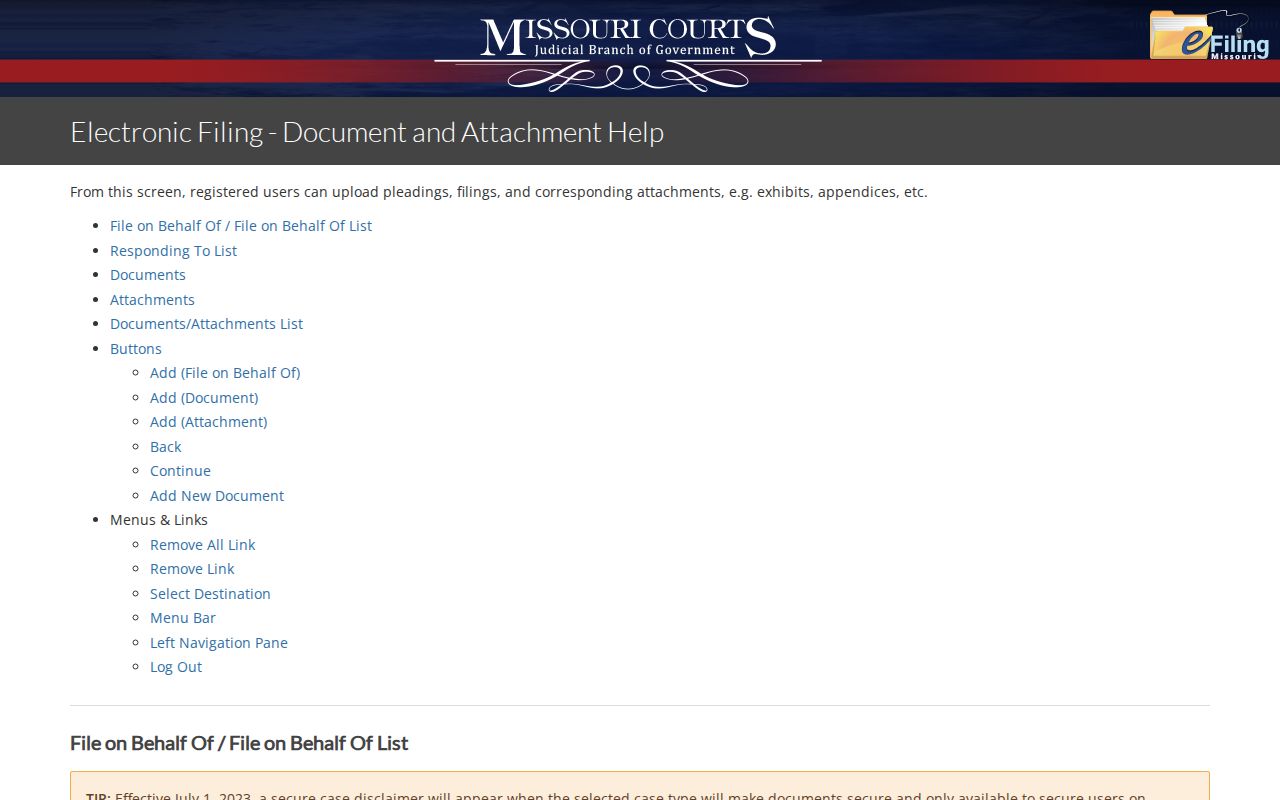
See a secure indicator or no public link? Ask the Circuit Clerk about record access. Do not assume the document was never filed. Do not assume it is open to everyone either.
For an eligible official copy, gather the case number, the document type, the docket-entry date, and the certification you want. Then ask the clerk about current payment and delivery requirements.